Smart Home Wiring: What NC Electricians Actually Install
There is a lot of marketing around smart home technology. This is what the wiring actually involves and which parts are worth the money.
Smart home is a broad category that covers everything from a plug-in smart outlet to a six-figure whole-home automation system. What I deal with as a licensed electrician in NC is the wiring infrastructure underneath all of it. The technology changes fast. The electrical requirements do not.
When a homeowner in Concord or Albemarle calls about smart home wiring, they are usually asking one of three things: can my existing wiring handle smart switches, do I need low-voltage runs for anything, or should I install a structured wiring panel. Sometimes all three. I want to give clear answers to each.
Smart switches: what the wiring actually requires
Standard smart switches work on your existing 120V circuits. The issue is the neutral wire. A traditional three-way or single-pole switch works by interrupting the hot wire only. No neutral is needed at the switch location because the switch does not consume any power itself. Smart switches are different because they draw a small amount of power continuously to maintain their wireless connection and run the microprocessor inside them.
That means most smart switches require a neutral wire at the switch box. In homes built before roughly 1985 in North Carolina, the wiring is often a switch leg, which is a two-wire run with no neutral at the switch box. If you buy a standard Kasa, Leviton Decora Smart, or similar dimmer and crack open the box, you may find only a black and a white wire twisted together for the always-hot and the load, with no separate neutral available.
Lutron Caseta is the exception. Caseta uses a 434 MHz RF mesh protocol called Clear Connect. The switches communicate through a Lutron Smart Bridge Pro or the basic Smart Bridge, which connects to your router. Because communication happens via radio, not over the neutral wire, Caseta dimmers do not need a neutral in the box. This is the reason I recommend Caseta for retrofit installations in older homes. It is reliable, it has the widest dimmer compatibility I have seen for LED fixtures, and it solves the neutral problem without running new wire.
If you are doing new construction or a renovation where walls are open, this conversation is different. Every switch location should get a neutral run in. That opens the full range of compatible hardware and keeps the wiring standard for future upgrades.
Three-way and four-way smart switching
Three-way switching, two switches controlling one light, is where standard smart switch installs get more complicated. Most smart switch systems solve this with a main smart switch at one location and a “remote” or “accessory” switch at the other. The Caseta system does this with a Pico remote, which is a battery-powered wireless paddle that mounts in a standard single-gang box with a mounting bracket. No additional wiring is needed at the second switch location.
Other brands use a traveler wire approach, which requires that the original three-way wiring is intact and accessible. If your three-way wiring is a two-wire run between boxes with the traveler shared on the neutral conductor, some smart switch brands cannot use it at all. This is the kind of thing worth checking before buying a full system.
Low-voltage rough-in for smart home infrastructure
Low-voltage wiring covers data, speaker wire, security camera runs, and doorbell wiring. This is separate from your 120V and 240V electrical circuits. In NC, low-voltage rough-in work does not require an electrical permit when done as standalone work, but it often happens alongside permitted electrical work during renovation or new construction.
Cat6A is the right choice for any data run installed today. Cat5e is fine for 1 Gbps to a desktop or smart TV, but Cat6A carries 10 Gbps up to 100 meters and supports Power over Ethernet devices like access points, IP cameras, and smart locks with built-in readers. The incremental cost difference between Cat5e and Cat6A is minimal when you are already pulling wire. Running Cat5e and wishing you had Cat6A in four years is a common frustration.
Speaker wire is typically 16-gauge or 14-gauge, run in pairs to each in-ceiling or in-wall speaker location. If you are installing a dedicated home theater, 12-gauge is worth using for longer runs. Speaker wire does not terminate in your panel. It terminates at a keystone plate or at a structured wiring panel if you have one.
Structured wiring panels: what they are and when they make sense
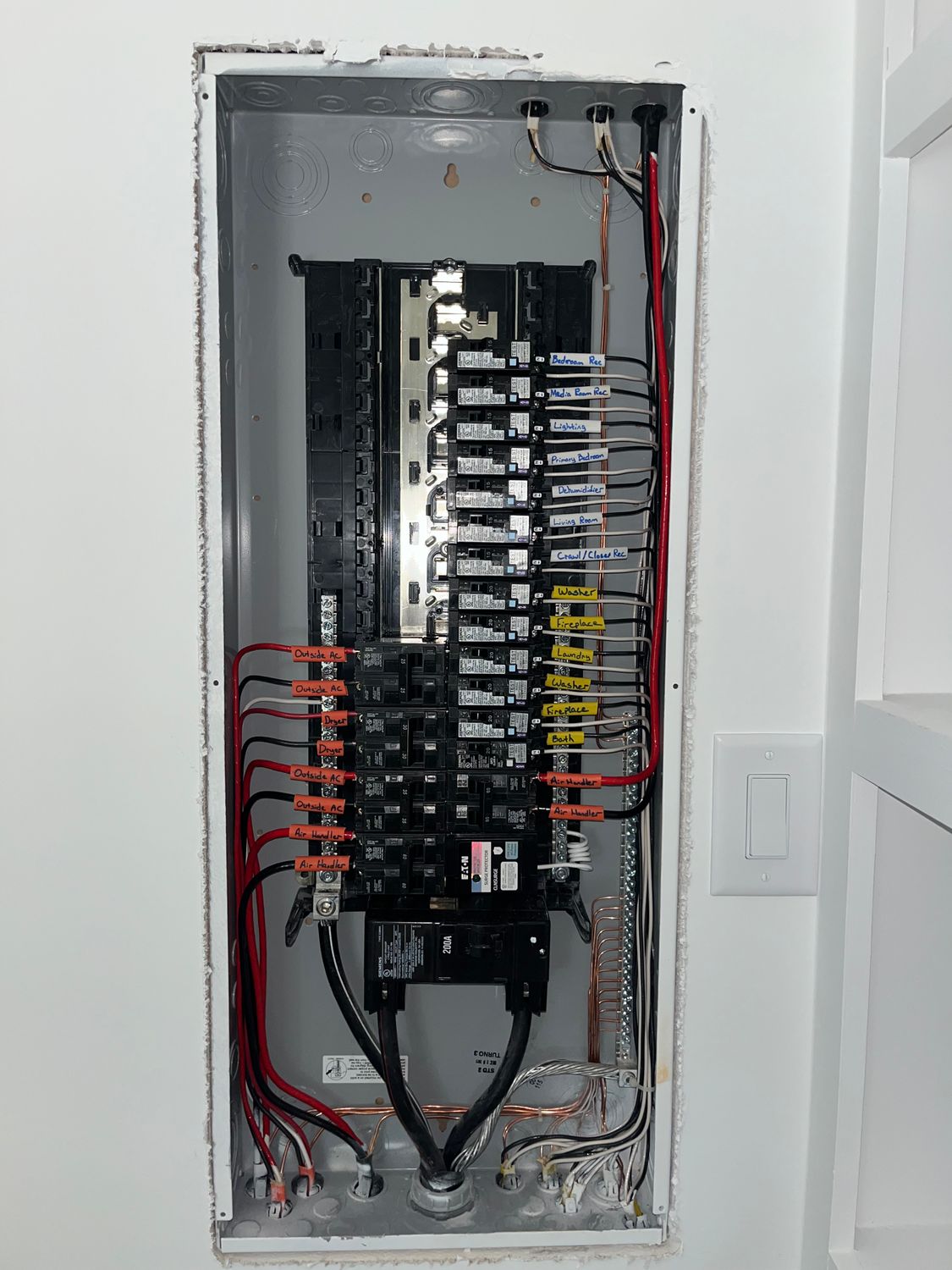
A structured wiring panel is a plastic or metal enclosure, typically mounted in a utility closet or mechanical room, that serves as the distribution point for all low-voltage runs in the home. Cat6 data cables, coaxial runs, speaker wire, and security system cables all home-run to this panel. Patch panels, switches, and splitters live inside it. Your router, network switch, and any whole-home audio distribution equipment mount here.
In new construction, installing a structured wiring panel is straightforward and worth doing if you plan to have more than three or four data drops in the house. Home-running everything to one location means troubleshooting is fast and upgrades happen in one place. I have run 12 or more Cat6A drops to a single panel on larger homes in the Cabarrus and Union County area and the organization pays off for the life of the house.
In a finished home, retrofitting a structured wiring panel is labor-intensive. You are pulling wire through finished walls and ceilings, which means cuts, patches, and painting. Unless you are doing a significant renovation where walls are already open, the disruption usually does not justify the result. Most finished-home retrofits are better served by a good Wi-Fi mesh system with a network switch tucked in a closet.
What requires a permit in NC
Any work that involves adding or modifying your electrical service, installing a sub-panel, or running new 120V or 240V circuits requires a permit and a licensed electrician in North Carolina. Low-voltage wiring, including Cat6 and speaker wire, does not require a separate permit. Smart switch replacement on existing circuits does not require a permit for a licensed homeowner performing work on their own primary residence, but cannot be done by an unlicensed person for hire.
If you are planning smart home work that includes new circuits for outdoor smart lighting, a dedicated circuit for home automation controllers, or any new service capacity, plan on a permit and a licensed contractor. The Cabarrus County and Union County permit offices are straightforward to work with and the inspections go quickly on standard work.
What is worth the money and what is not
Smart switches on your most-used circuits, living room, kitchen, and bedroom dimmers, are worth it. The convenience and the energy savings on LED dimmers are real. A Lutron Caseta starter kit covering four or five locations is a reasonable investment.
Whole-home audio systems with in-ceiling speakers in every room are expensive to wire properly and more expensive to install correctly. They make sense if you actually use them. Most people I have talked to a few years after installation use speakers in two or three rooms and regret not doing a simpler system.
Smart panels, the kind that give you per-circuit monitoring and remote breaker control, are a new category worth watching but not yet standardized enough to recommend broadly. The hardware is expensive and the software ecosystems are still evolving. If you are doing a full service upgrade anyway, it may be worth the premium. If your existing panel is functional, it is not worth replacing it for monitoring alone.
If you are in Norwood, Concord, Charlotte, or anywhere in the Piedmont corridor and want to talk through what your smart home project actually requires, call 310 Construction at (704) 575-9463. We will look at your existing wiring, tell you what the project actually involves, and give you a straight quote. No upsell on hardware you do not need. You can also reach us through the contact page.
Questions about smart home wiring in NC
Do smart switches require a neutral wire?
Does smart home wiring require a permit in NC?
What is a structured wiring panel and do I need one?
How much does a Lutron Caseta installation cost?
What smart home work can I do myself in NC?
What Cat cable should I run for new low-voltage drops?
Planning smart home wiring in central NC?
310 Construction scopes smart switch, low-voltage, and structured wiring work across Cabarrus, Union, and Stanly counties. Call or contact us for a straight quote on what the project actually involves.